
In 2004, a local geology student found the skull of Fedexia striegeli in Western Pennsylvania. The specimen lay at the base of a road cut exposing the Casselman Formation. The Casselman is the formation above the Ames Limestone. The geologic age is not exact. The fossilized skull was found at the base rather than pulled from the hillside. Estimates place it at around 305 million years old.
Finding any sort of amphibian fossil in Pennsylvania would be a huge deal. This specimen, found by Adam Striegel, a University of Pittsburgh student, pushed back the earliest known record of the Trematopidae, a group of carnivorous amphibians, by almost 20 million years.
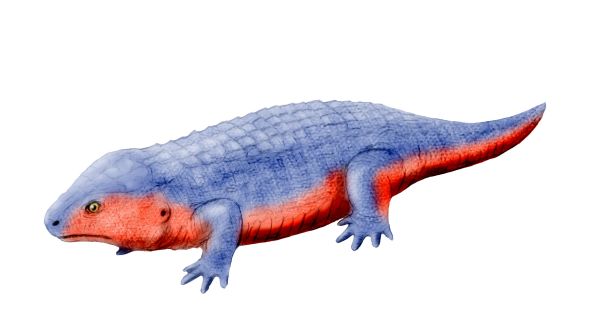
striegeli © N. Tamura
Location of Discovery
Upon discovering the fossil, Mr. Striegel originally thought he had found a fern fossil. The discovery occurred on land owned by FedEx near the Pittsburgh International Airport in Moon Township. Thus, the genus was named Fedexia for FedEx, and the species is striegeli for the discoverer.
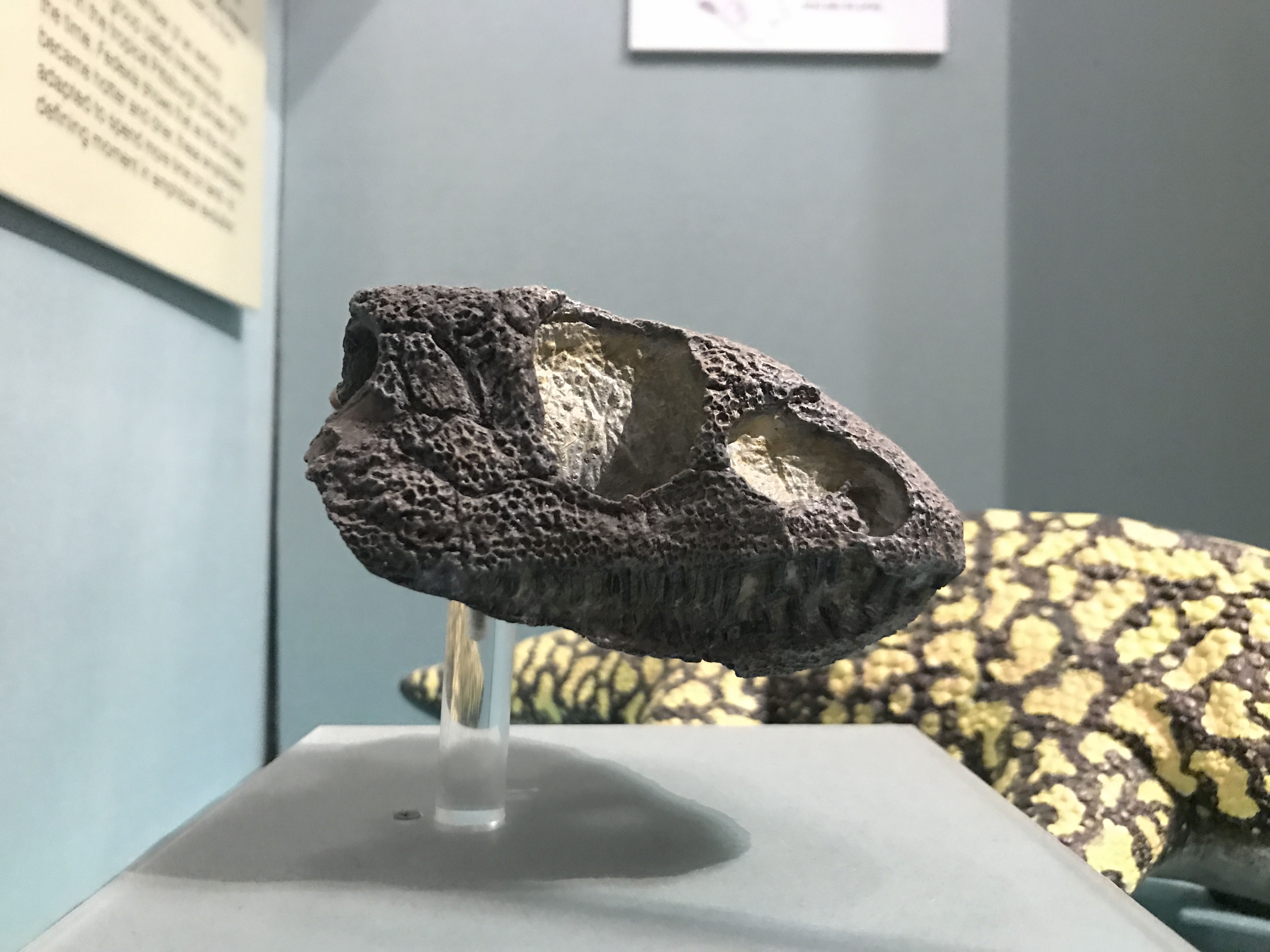
Trematopids in the Pennsylvanian Subperiod
Before the discovery of Fexedia, only three reports from the Trematopidae family came from the Pennsylvanian subperiod of time. Previous finds included Anconastes vesperus (CM 41711) in New Mexico (Berman et al 1986) and Actiobates peabodyi in Kansas (Eaton 1973).
Pennsylvanian Trematopid Discoveries
| 2004 | Pennsylvania | Fexedia striegeli |
| 1986 | New Mexico | Anconastes vesperus |
| 1973 | Kansas | Actiobates peabodyi |
Perceived Age of Pennsylvanian Trematopid Discoveries
In the type species paper (Berman, Henrici, Brezinski, Kollar, 2010), there is a chart (Fig. 3) showing geological age information of these three discoveries. The correlation between species and climate is shown using sea level, precipitation, glacial frequency, and glacial extent. Using this chart, I made rough estimates of the perceived ages of these three species, each within ±3 million years.
| 302 mya | New Mexico | Anconastes vesperus |
| 305 mya | Pennsylvania | Fexedia striegeli |
| 306 mya | Kansas | Actiobates peabodyi |
Other Vertebrate Fossils in Pittsburgh, Pennsylvania
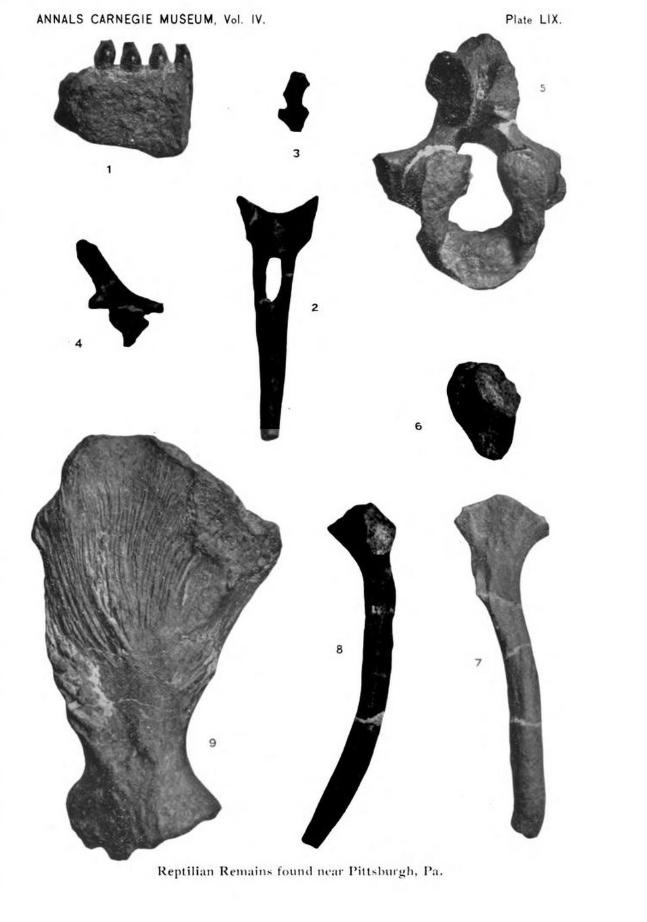
While scarce, vertebrate fossils can be found in the Pittsburgh region. In the Annals of the Carnegie Museum, Volume 4 (1906-1908), E.C. Case describes vertebrate fossil remnants found in Pitcairn, PA. They appear to be within the Pittsburgh Red Beds, which sit below the Ames Limestone. The author reported the fossils from four feet above the base of the 37-foot-thick red clay.
In the paper published in the Annals of the Carnegie Museum, Volume 78, No. 4, the Pitcairn specimens were mentioned in relation to the discovery of Fedexia.
More Information about Fedexia striegeli
- ScienceDaily – Fossil of early terrestrial amphibian discovered
- Article on Wikipedia
- D.S. Berman, A.C. Henrici, D.K. Brezinski, A.D. Kollar (2010) – A New Trematopid Amphibian (Temnospondyli: Dissorophoidea) from the Upper Pennsylvanian of Western Pennsylvania: Earliest Record of Terrestrial Vertebrates Responding to a Warmer, Drier Climate – Annals of Carnegie Museum Vol 78, No 4.
More Information on Pennsylvanian Trematopids and Vertebrate Fossils
- D.S. Berman, R.R. Reisz & D.A. Eberth (1986) – A new genus and species of trematopid amphibian from the Late Pennsylvanian of north-central New Mexico
- T.H. Eaton (1973) – A Pennsylvanian Dissorophid Amphibian from Kansas
- E.C. Case – Description of Vertebrate Fossils from the vicinity of Pittsburgh, Pennsylvania (Pages 234-241) – Annals of Carnegie Museum Vol 4.