
Order Ostreida Férussac, 1822
Family Pinnidae Leach, 1819
Genus Allopinna Yancey, 2024
Species godleskya Yancey, 2024
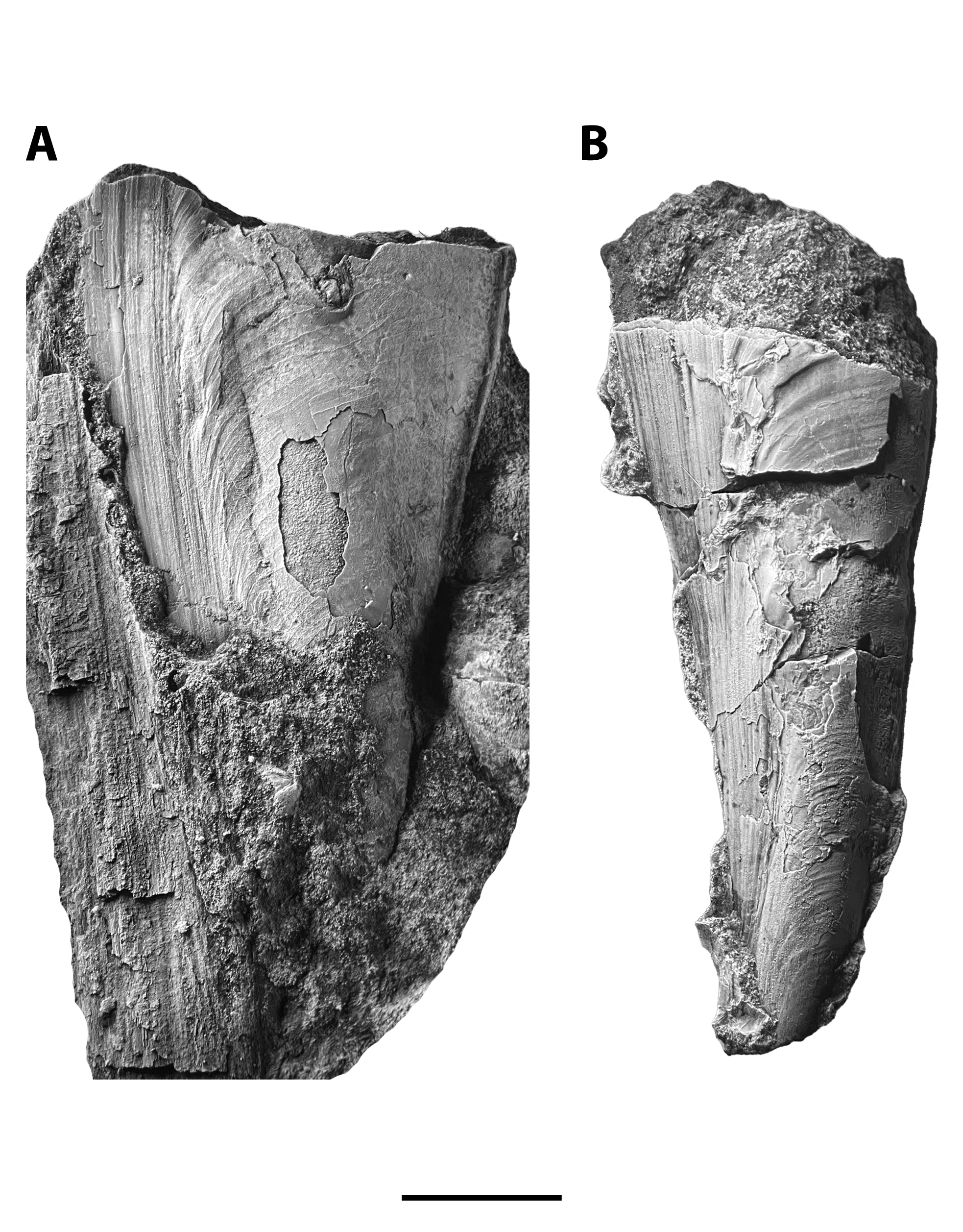
Thomas E. Yancey named the genus Allopinna and its only species, A. godleskya, in 2024, in a revision of the late Paleozoic pinnids of North America (Yancey, 2024). The holotype (CM 54677) and 19 paratypes (CM 54678–CM 54696) are housed at the Carnegie Museum of Natural History; all came from the Brush Creek limestone of Parks Township. The genus name reflects an apparent resemblance to Orthopinna that hides several differences, and Yancey named the species for Clinton Godlesky (me), as the collector of the type material.
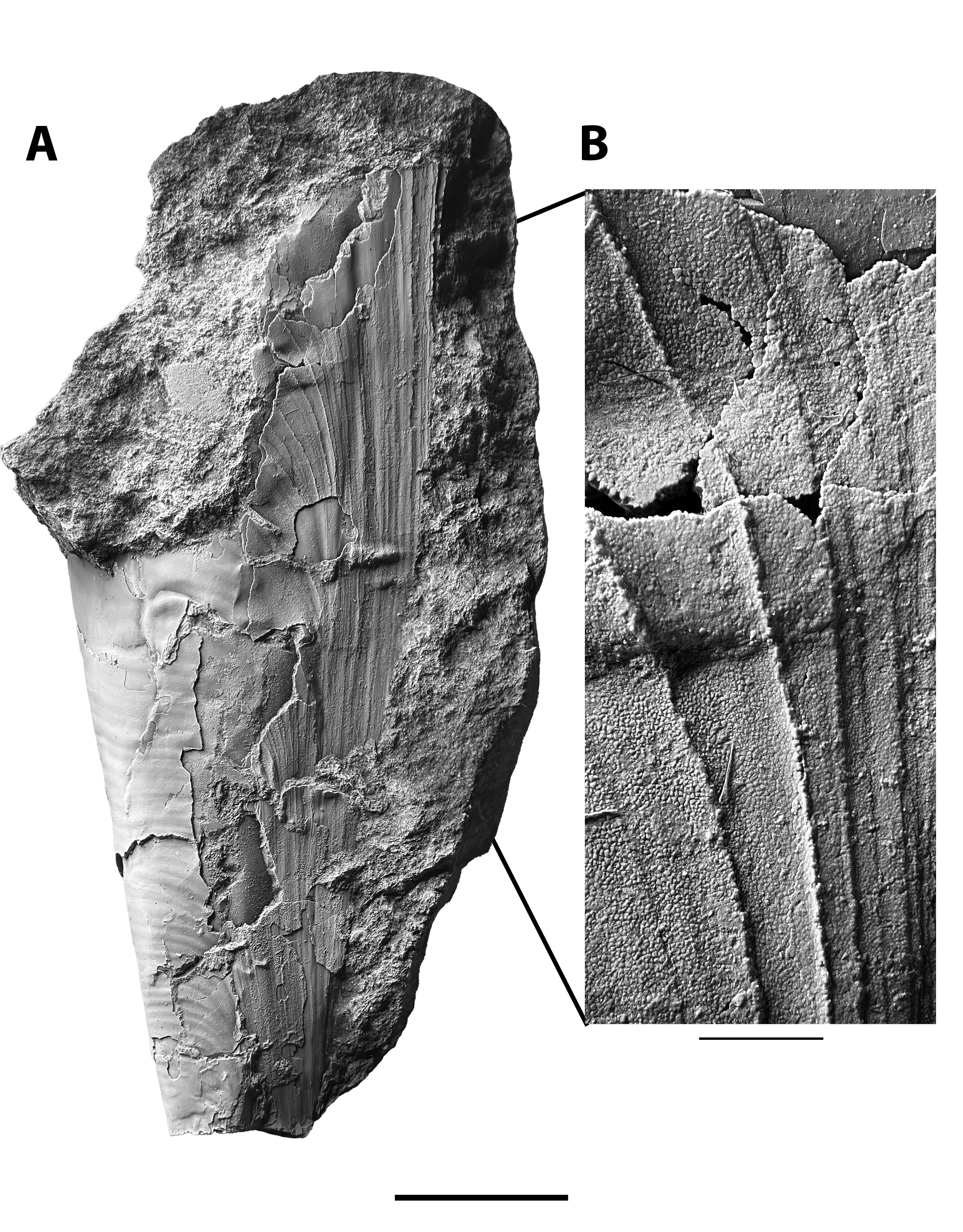
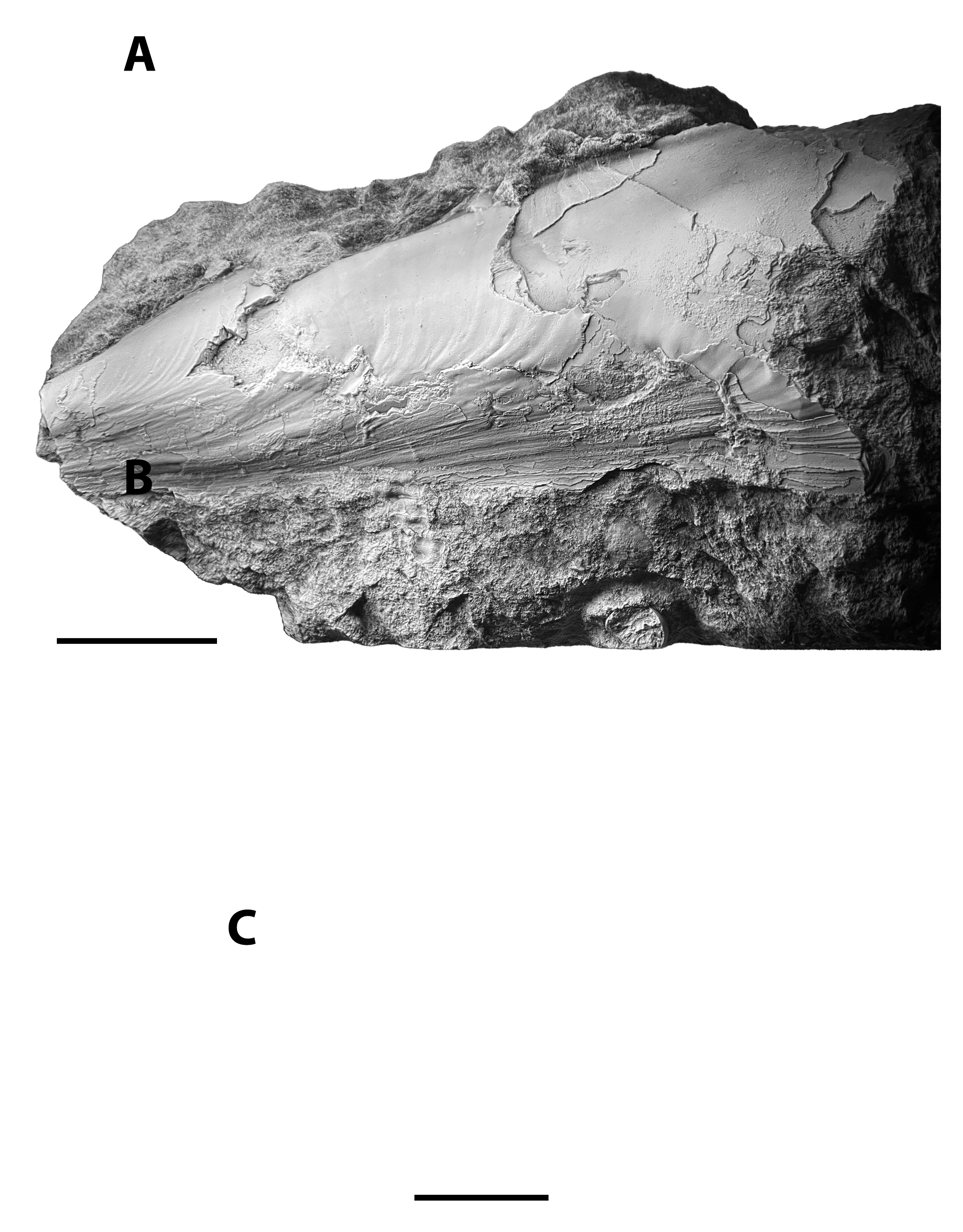
Allopinna godleskya is a well-inflated, thick-shelled pinnid. Its slender anterior shell is nearly circular in cross section for the first 4 cm, and the apical angle widens from about 15° to 20–25° on the middle of the shell. Tiny upturned lamellae, about 0.7 mm apart, run along the growth lines of the middle and posterior shell. Among Paleozoic pinnids, such lamellae were known before only in Meekopinna, and Yancey (2024) considers them to have evolved independently in the two genera. The largest specimens studied are 11 cm long, but full-grown shells may have been half again as long.
The pinnid Allopinna godleskya is common in the Brush Creek limestone in Parks Township. In life, extant pinnids bury their anterior end in sediment and attach to the seafloor using a mass of byssus threads. I find most fossils of this species in life position, with the long axis of the shell perpendicular to the bedding (Yancey, 2024). The shells appear as sectioned, pointed oval shapes in the top portions of the limestone. These are the remains of the anterior end, which is the thicker part of the shell: as the animal grew, it backfilled the apex with secondary calcite.
Recovery is challenging since these are in the Brush Creek limestone. The prismatic outer layer, made of columns of calcite, sticks well to the limestone, and you can rarely recover good samples. I gathered over one hundred specimens in the first few years of fossil collecting. I found one exceptional example (CG-0112, now CM 54677) preserved splayed out flat, and it became the holotype.
The Ohio Pennsylvanian bivalve bulletin (Hoare, Sturgeon & Kindt, 1979) calls the local pinnids Pteronites. That followed the Treatise of the time, in which Cox and Hertlein (1969) treated Aviculopinna as a synonym of Pteronites; Yancey et al. (2023) later showed that Pteronites belongs to a different family, the Pterineidae. Yancey (2024) suggests that the Brush Creek pinnids figured from Ohio by Hoare et al. (1979, pl. 4) may be A. godleskya, but those specimens can no longer be located.
References
- Anelli, L. E., Rocha-Campos, A. C., and Simões, M. G., 2006, Pennsylvanian Pteriomorphian bivalves from the Piaui Formation, Parnaiba Basin, Brazil., Journal of Paleontology 80(6):1125–1141.
- Dauphin, Y. et al., 2018, The Prismatic Layer of Pinna: A Showcase of Methodological Problems and Preconceived Hypotheses, Minerals, 19 Pages.
- Geinitz, H. B., 1848. Die Versteinerungen des Zechsteingebirges und Rothliegenden oder des Permischen Systemes in Sachsen, Part 1, Die Versteinerungen des Deutschen Zechsteingebirges. Arnoldische Buchhandlung, Dresden and Leipzig.
- Cox, L. R., and Hertlein, L. G., 1969. Superfamily Pinnacea, in Moore, R. C., ed., Treatise on Invertebrate Paleontology, Part N, Mollusca 6, Bivalvia, v. 1. Geological Society of America and University of Kansas Press, p. N281–N285.
- Hoare, R. D., Sturgeon, M. T., and Kindt, E. A., 1979. Bulletin 67: Pennsylvanian Marine Bivalvia and Rostroconchia of Ohio. Ohio Division of Geological Survey, 77 p., 18 pls.
- Meek, F.B., 1864, Remarks on the family Pteriidae, (=Aviculidae) with descriptions of some new fossil genera. The American Journal of Science and Arts, Second Series 37, pp. 212-220
- Münster, G. G., 1840, Beschreibung einiger seltenen Versteinerungen des Zechsteins. Beiträge zur Petrefacten-Kunde, p 45, Tab 3, Figure 4
- Shumard, B.F., Swallow, G.C., 1858, Descriptions of new fossils from the coal measures of Missouri and Kansas., St. Louis Academy of Science Transactions, p. 214
- Waller, T.R., 1978, Morphology, morphoclines, and a new classification of the Pteriomorphia (Mollusca: Bivalvia). Philosophical Transactions of the Royal Society of London, B 284:345–365
- Yancey, T.E., 1978, Brachiopods and mollusks of the Lower Permian Arcturus Group, Nevada and Utah, Pt. 1, Brachiopods, scaphopods, rostroconchs and bivalves. Bulletins of American Paleontology 74(303):257–367
- Yancey, T.E., Amler, M., Raczyński, P., & Brandt, S., 2023, Rebuilding the foundation of late Paleozoic pinnid bivalve study (family Pinnidae). Journal of Paleontology, 97(1), pp. 140-151.
- Yancey, T. E., 2024. Revision of Late Paleozoic Pinnid Genera and North American Species of Bivalve Family Pinnidae. Bulletins of American Paleontology 410:1–83. Paleontological Research Institution, Ithaca.

Late Carboniferous Fossils from the Glenshaw Formation in Armstrong County, Pennsylvania
Preface | The Photographic Process
Localities: Locality SL 6533 Brush Creek limestone | Locality SL 6445 Pine Creek limestone
Bivalvia: Allopinna | Parallelodon | Septimyalina
Cephalopoda: Metacoceras | Poterioceras | Pseudorthoceras | Solenochilus
Gastropoda: Amphiscapha | Bellerophon | Cymatospira | Euphemites | Glabrocingulum | Meekospira | Orthonychia | Patellilabia | Pharkidonotus | Retispira | Shansiella | Strobeus | Trepospira | Worthenia
Brachiopoda: Cancrinella | Composita | Isogramma | Kozlowskia | Linoproductus | Neospirifer | Parajuresania | Pulchratia