
Phylum Arthropoda Gravenhorst, 1843
Class Trilobita Walch, 1771
Order Proetida Fortey & Owens, 1975
Superfamily Proetoidea Hawle & Corda, 1847
Family Phillipsiidae Oehlert, 1886
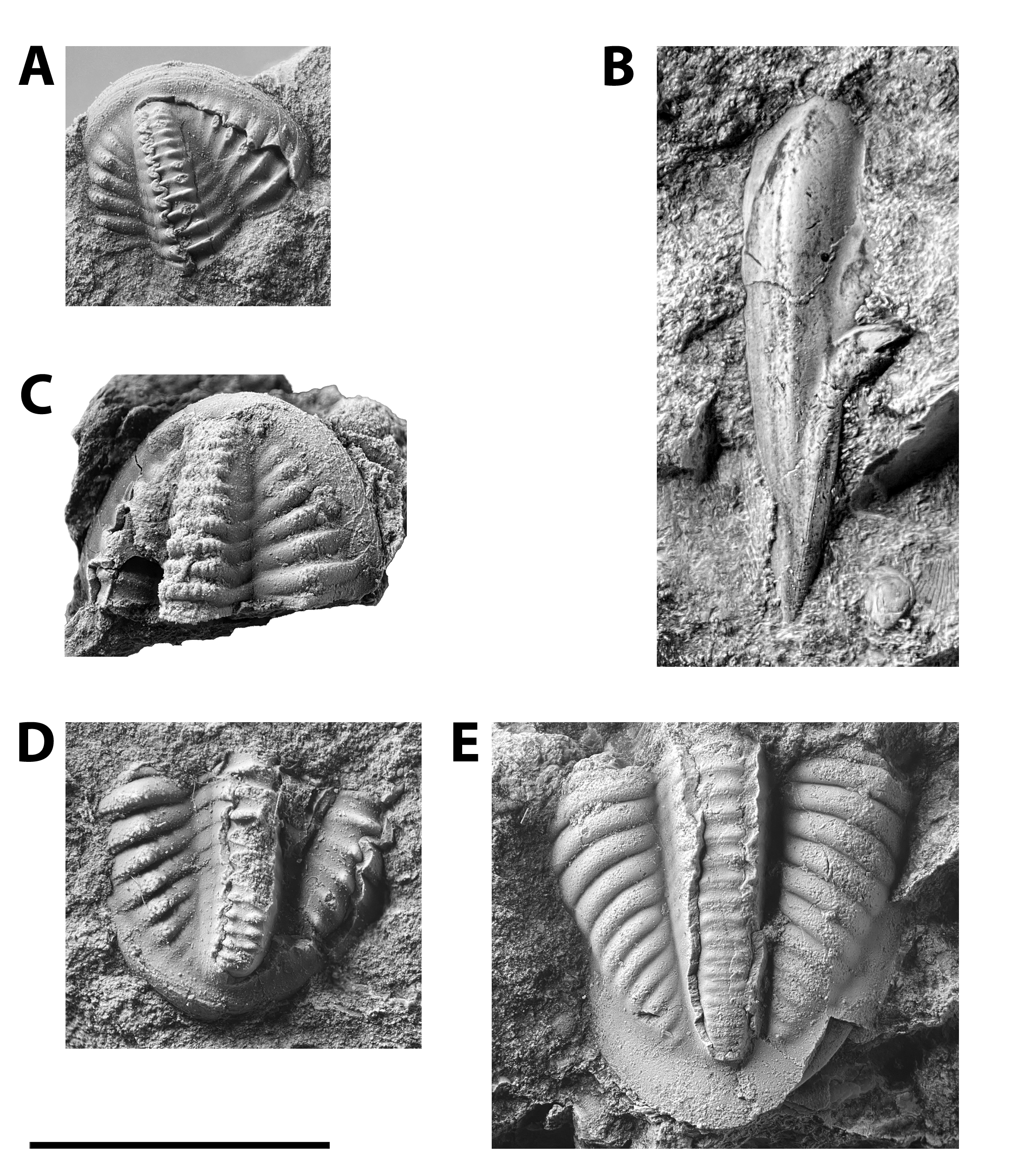
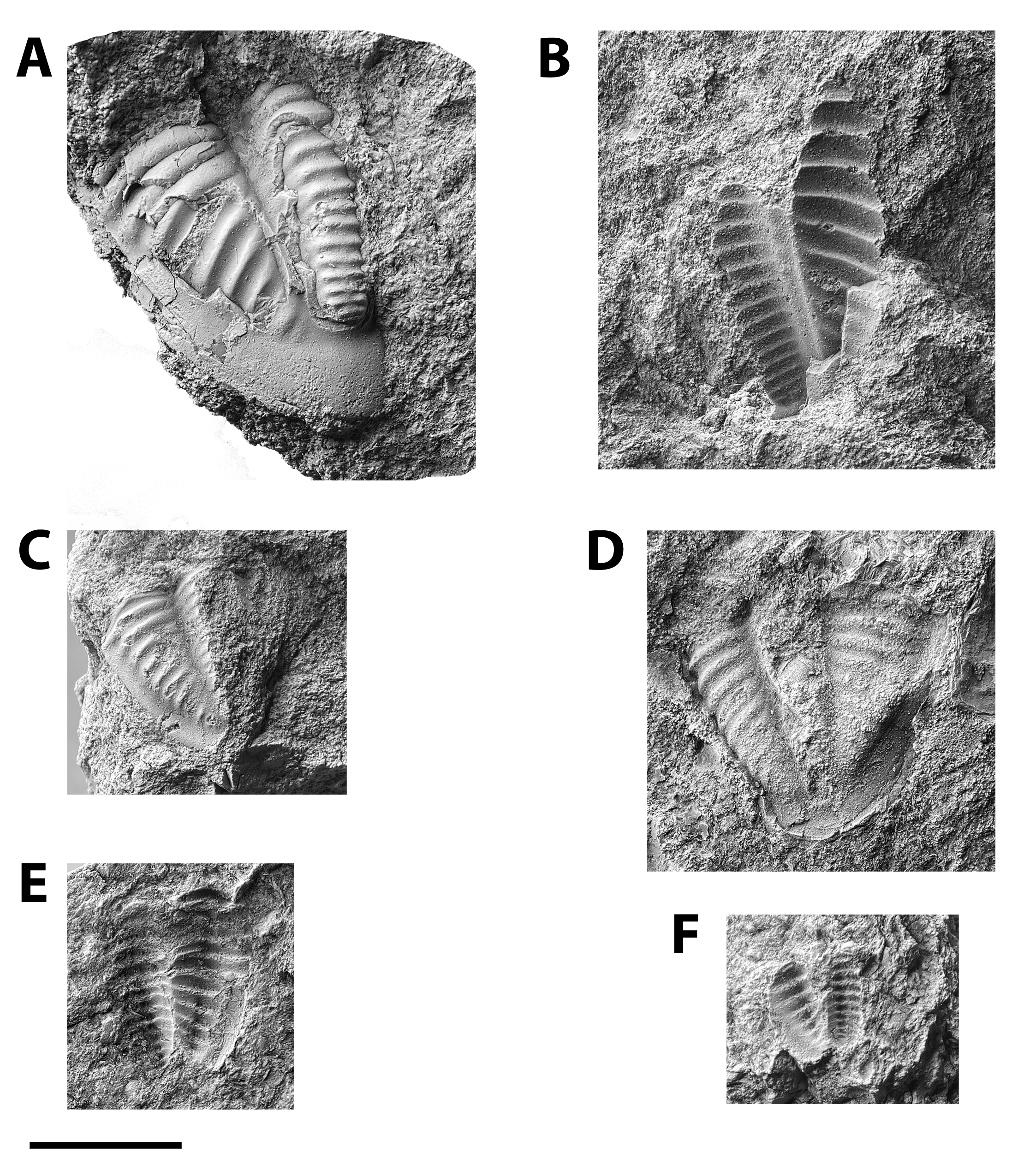
Both trilobite genera found in the Late Pennsylvanian rocks of Armstrong County belong to the family Phillipsiidae. Both are small compared to other extinct trilobites. Researchers have documented the shrinking of Trilobite species until their extinction at the end of the Permian during the most extensive mass extinction.
They are rare, with about a dozen examples recovered over three years of collection. The tail, known as the pygidium, is found more often than the thorax or cephalon (the head). In both locations, the chitin exoskeleton may have disarticulated after death, making complete specimens rare.
The Brush Creek and Pine Creek limestone in this part of Armstrong County contains only two genera–Ameura missouriensis and Ditomopyge scitula. The genus Ameura is rare and can attain lengths up to 7 cm, whereas the smaller Ditomopyge is the most common and maxes out at 3 cm (Babcock, 1996, p. 101). They appear similar at first glance, yet the relative height and width of the axial lobe are shorter and narrower in Ameura. Both disappeared from the fossil record before the Ames limestone (Brezinski et al., 1989) in local rocks, but both remain in the midcontinent.
Brezinski et al. (1989) studied the morphological variation of Ditomopyge scitula across the Pottsville, Allegheny, and Conemaugh Groups. The average pygidial width dropped by 2 mm, the pygidial length by 2.5 mm, and the average number of pleural ribs and axial rings reduced. While there is no confirmed reason, all trilobites continued to decrease in average size until their extinction.
References
- Brezinski, D.K., Sturgeon, M.T., Hoare, R.D., 1989. Pennsylvanian Trilobites of Ohio, Report on Investigations No. 142
- Hawle, I. & Corda, J.C., 1847. Prodrom einer Monographie der böhmischen Trilobiten. J.G. Calvesche Buchhandlung, Prague, 176 pp
- Oehlert, D. P., 1886. Étude sur quelques trilobites du groupe de Proetidae. Bulletine Society Étude Scientifique d’Angers, 15, 121–143.
- Shimer, H. W, Shrock, R. R., 1944. Index Fossils of North America, P. 637, 645, 648
- Walch, J. E. I., 1771. Die Naturgeschichte der Versteinerungen, zur Erläuterung der Knorrischen Sammlung von Merkwurdigkeiten der Natur, Volume 4, Part 3. (J.P. Felßecker: Nürnberg) 303 pp

Late Carboniferous Fossils from the Glenshaw Formation in Armstrong County, Pennsylvania
Preface | The Photographic Process
Localities: Locality SL 6533 Brush Creek limestone | Locality SL 6445 Pine Creek limestone
Bivalvia: Allopinna | Parallelodon | Septimyalina
Cephalopoda: Metacoceras | Poterioceras | Pseudorthoceras | Solenochilus
Gastropoda: Amphiscapha | Bellerophon | Cymatospira | Euphemites | Glabrocingulum | Meekospira | Orthonychia | Patellilabia | Pharkidonotus | Retispira | Shansiella | Strobeus | Trepospira | Worthenia
Brachiopoda: Cancrinella | Composita | Isogramma | Linoproductus | Neospirifer | Parajuresania | Pulchratia