
Order Nautilida Agassiz, 1847
Family Solenochilidae Hyatt, 1893
Genus Solenochilus Meek & Worthen, 1870
Meek & Worthen (1870) named Solenochilus, as a subgenus of Nautilus, for a group of coiled nautiloids that D’Orbigny had called Cryptoceras in 1850. A new name was needed because Joachim Barrande had already used Cryptoceras in 1846 for a very different group of cephalopods. Barrande later renamed that genus Ascoceras—according to Meek & Worthen, because Latreille had used the similar name Cryptocerus for a genus of Hymenoptera (ants, bees and wasps) in 1804. Either way, Meek & Worthen argued, D’Orbigny’s name could not stand. The new name joins the Greek sōlēn (channel) and cheilos (lip): on each side, the lip of these shells is drawn out into “a kind of little canal, or spout-like channel.” Meek & Worthen took Nautilus (Cryptoceras) springeri White & St. John, 1868, as the type of the group. Solenochilus is now treated as a full genus; the spelling Solenocheilus, used in some older works, is a later variant introduced by Hyatt.
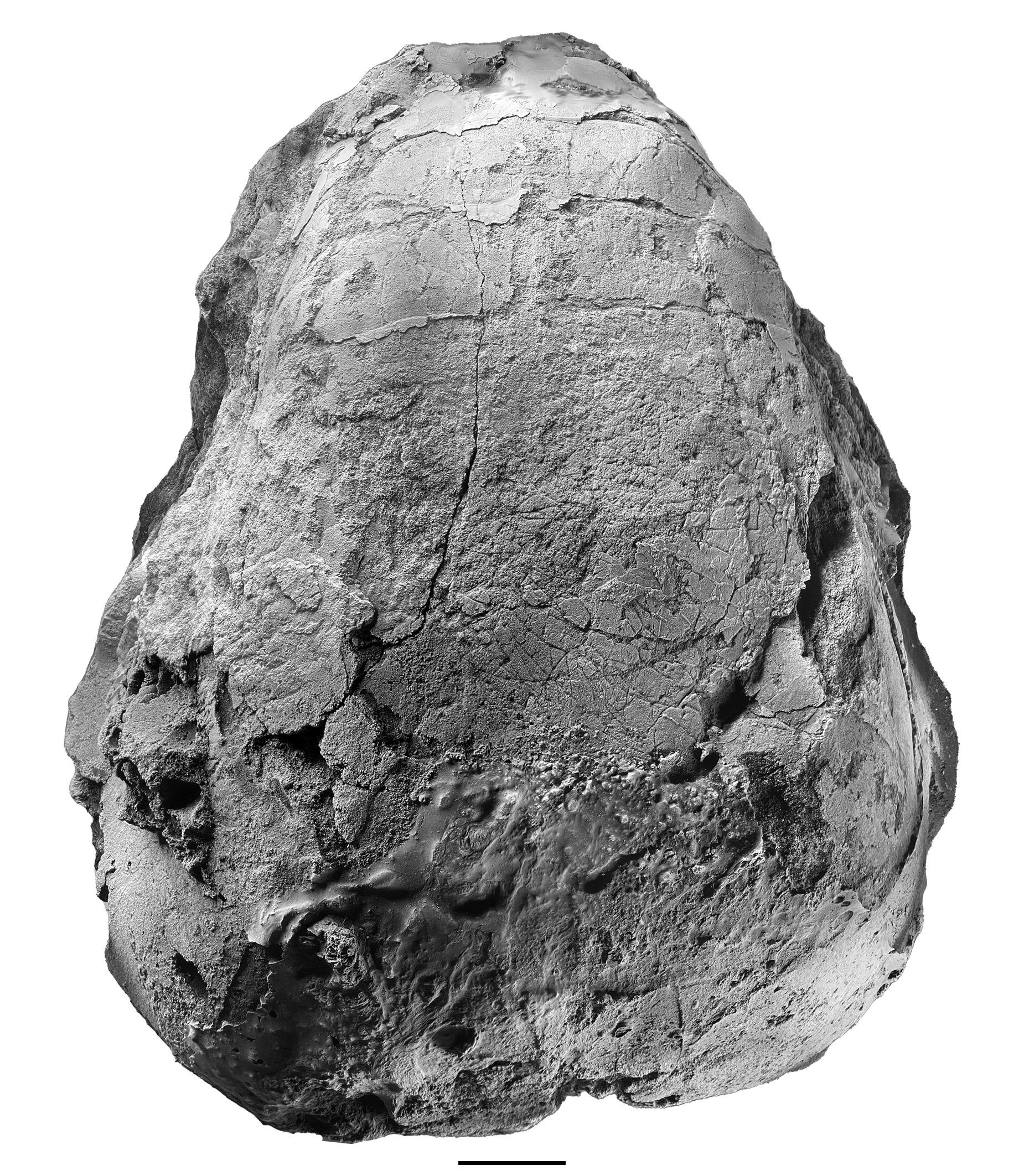
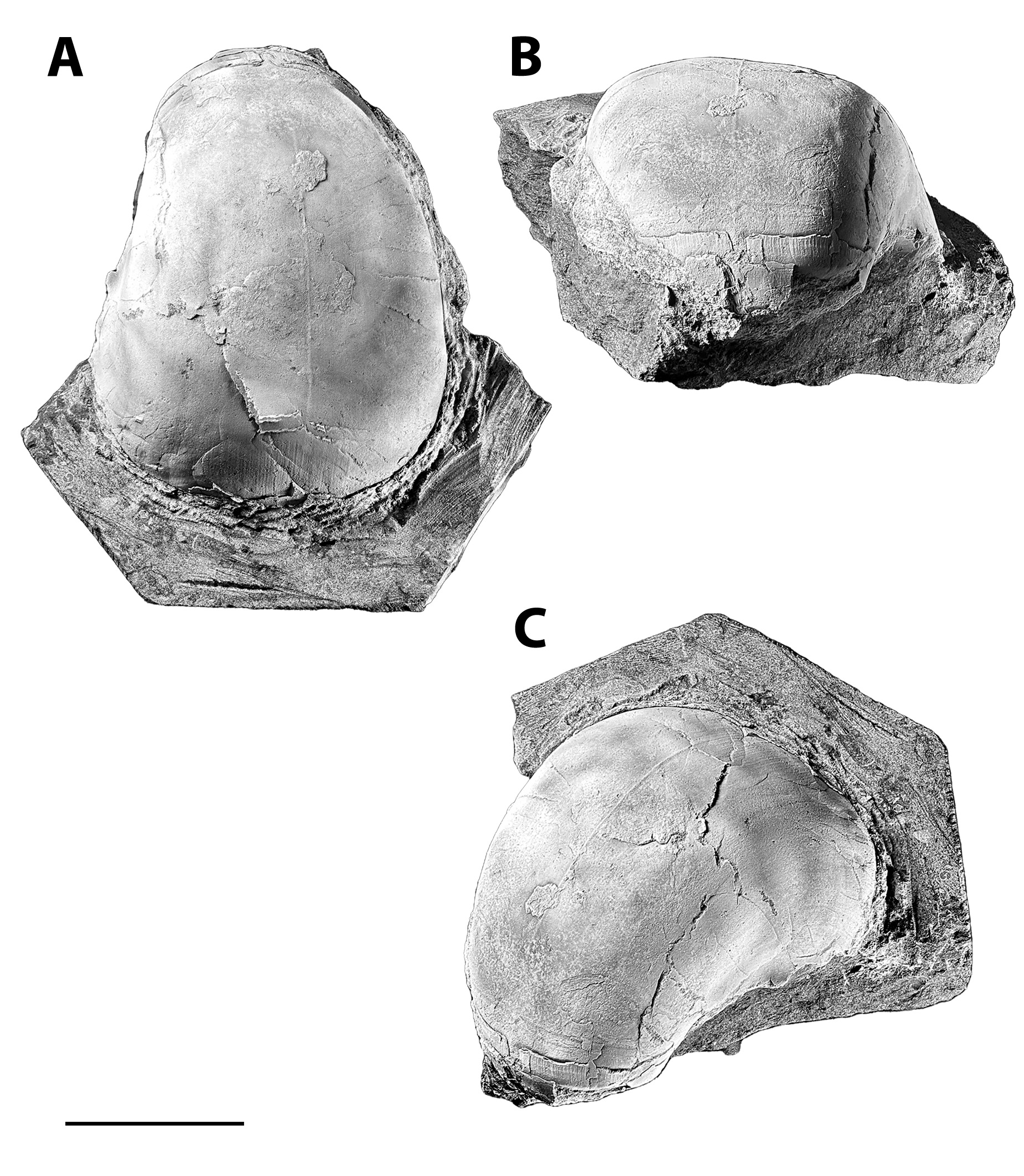
Solenochilus shells are large, loosely coiled and rapidly expanding, with a broad, depressed whorl, nearly straight sutures and a small siphuncle against the outer (ventral) wall. Mature shells were about 100 to 200 mm across and grew a pair of long, hollow spines from the shoulders beside the aperture (Mikesh & Glenister, 1966). The spines are almost always broken away, and their function is still unknown (Sturgeon et al., 1997). Specimen CG-0046 preserves the base of one spine. In the field, Solenochilus is most easily confused with Ephippioceras, but that genus has a strongly U-shaped ventral lobe in the suture and matures at only about 50–65 mm across, whereas some Solenochilus approach 300 mm in diameter (R. H. Mapes, pers. comm., 26 July 2019). Gordon (1964) listed 24 species and gave a key to the North American ones.
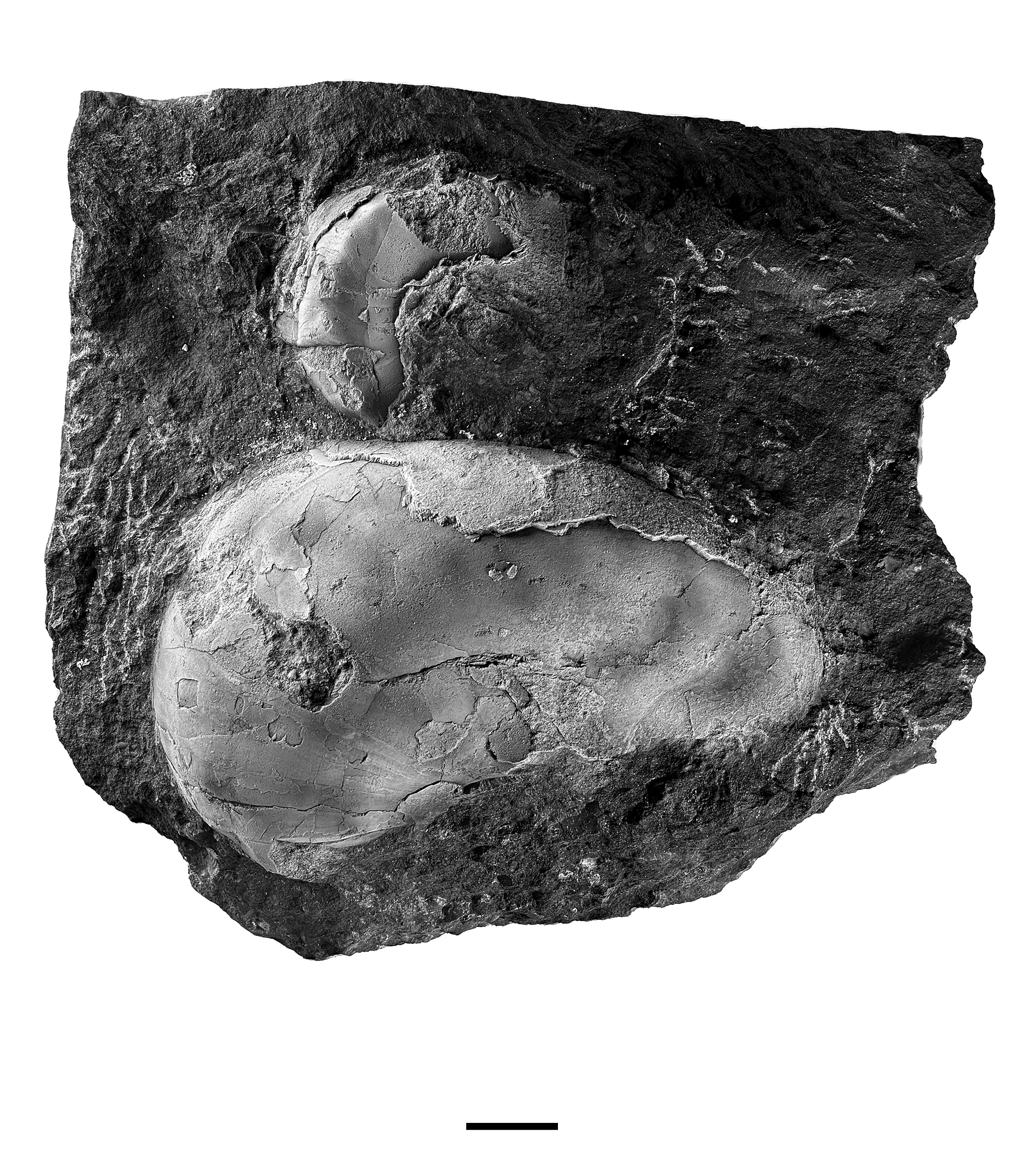
In western Pennsylvania, Raymond (1910) reported Solenochilus from the Brush Creek at Donohoe and Blackburn and from the Pine Creek at Allegheny (Miller & Unklesbay, 1942). Miller and Unklesbay (1942) referred 11 incomplete, mostly crushed specimens from the Brush Creek (near Creighton, at Glassmere and west of Murrysville) and the Pine Creek (Powers Run) questionably to S. brammeri; the largest measured about 125 mm across, against about 300 mm for that species’ holotype. The holotype of S. brammeri is in the Yale Peabody Museum (YPM 14006), from the Late Pennsylvanian of Cass County, Nebraska (White & Skorina, 1999). Murphy (1970) left three poorly preserved Brush Creek specimens as Solenochilus sp., noting that such material had been referred to either S. brammeri or S. missouriensis. Sturgeon et al. (1997) recognized two species in the Brush Creek of Ohio, S. mcfarlandi and S. johnstoni, while S. cambridgensis comes from the younger Cambridge limestone (Frontz, 1966). Because most local specimens are fragments, the ones figured here are left as Solenochilus sp., as is common for poorly preserved material elsewhere (Niko & Mapes, 2016).
Some local shells record encounters with predators. CG-0043 (Fig. 1), a juvenile, has three evenly spaced circular punctures near the aperture that R. H. Mapes considered probable shark bites (pers. comm., 22 March 2020). Mapes and Hansen (1984) attributed a similar set of punctures on a Pennsylvanian coiled nautiloid to the shark Symmorium reniforme, and Hansen and Mapes (1990) described an orthoconic nautiloid with perforations matching the teeth of Petalodus ohioensis (Mapes & Chaffin, 2003). Petalodus teeth occur with Solenochilus in the Brush Creek limestone at SL 6533 (Fig. 3).
References
- Frontz, H. O., 1966. New Solenochilus species from the Conemaugh Series of eastern Ohio. Ohio Journal of Science 66(4):433–436.
- Gordon, M., Jr., 1964. Carboniferous cephalopods of Arkansas. U.S. Geological Survey Professional Paper 460.
- Hansen, M. C., and Mapes, R. H., 1990. A predator-prey relationship between sharks and cephalopods in the late Paleozoic, in Boucot, A. J., Evolutionary Paleobiology of Behavior and Coevolution. Elsevier, Amsterdam, p. 189–192.
- Mapes, R. H., and Chaffin, D. T., 2003. Predation on cephalopods: a general overview with a case study from the Upper Carboniferous of Texas, in Kelley, P. H., Kowalewski, M., and Hansen, T. A., eds., Predator–Prey Interactions in the Fossil Record. Kluwer Academic/Plenum, New York, p. 177–213.
- Mapes, R. H., and Hansen, M. C., 1984. Pennsylvanian shark-cephalopod predation: a case study. Lethaia 17:175–183.
- Meek, F. B., and Worthen, A. H., 1870. Descriptions of new species and genera of fossils from the Palaeozoic rocks of the western states. Proceedings of the Academy of Natural Sciences of Philadelphia 22:22–56 (Solenochilus, p. 47–48).
- Mikesh, D. L., and Glenister, B. F., 1966. Solenochilus springeri (White & St. John, 1868) from the Pennsylvanian of southern Iowa. Proceedings of the Iowa Academy of Science 73:269–278.
- Miller, A. K., and Unklesbay, A. G., 1942. The cephalopod fauna of the Conemaugh Series in western Pennsylvania. Annals of the Carnegie Museum 29:127–174.
- Murphy, J. L., 1970. Coiled nautiloid cephalopods from the Brush Creek Limestone (Conemaugh) of eastern Ohio and western Pennsylvania. Journal of Paleontology 44(2):195–205.
- Niko, S., and Mapes, R. H., 2016. Late Carboniferous coiled nautiloids from the Lost Branch Formation of Oklahoma, Midcontinent North America. Paleontological Research 20(2):75–79.
- Raymond, P. E., 1910. A preliminary list of the fauna of the Allegheny and Conemaugh Series in western Pennsylvania. Annals of the Carnegie Museum 7:144–158.
- Sturgeon, M. T., Windle, D. L., Jr., Mapes, R. H., and Hoare, R. D., 1997. Pennsylvanian cephalopods of Ohio. Part 1, nautiloid and bactritoid cephalopods. Ohio Division of Geological Survey, Bulletin 71, p. 1–191.
- White, C. A., and St. John, O. H., 1868 (1867). Descriptions of new Subcarboniferous and Coal Measures fossils collected upon the geological survey of Iowa. Transactions of the Chicago Academy of Sciences 1:115–127.
- White, R. D., and Skorina, L. K., 1999. A type catalog of fossil invertebrates (Mollusca: Actinoceratoidea, Bactritoidea, Endoceratoidea and Nautiloidea) in the Yale Peabody Museum. Postilla 219:1–37.

Late Carboniferous Fossils from the Glenshaw Formation in Armstrong County, Pennsylvania
Preface | The Photographic Process
Localities: Locality SL 6533 Brush Creek limestone | Locality SL 6445 Pine Creek limestone
Bivalvia: Allopinna | Parallelodon | Septimyalina
Cephalopoda: Metacoceras | Poterioceras | Pseudorthoceras | Solenochilus
Gastropoda: Amphiscapha | Bellerophon | Cymatospira | Euphemites | Glabrocingulum | Meekospira | Orthonychia | Patellilabia | Pharkidonotus | Retispira | Shansiella | Strobeus | Trepospira | Worthenia
Brachiopoda: Cancrinella | Composita | Isogramma | Kozlowskia | Linoproductus | Neospirifer | Parajuresania | Pulchratia