
Class Rhynchonellata Williams, 1996
Order Dictyonellida Cooper, 1956
Family Isogrammidae Schuchert, 1929
Genus Isogramma Meek & Worthen, 1870
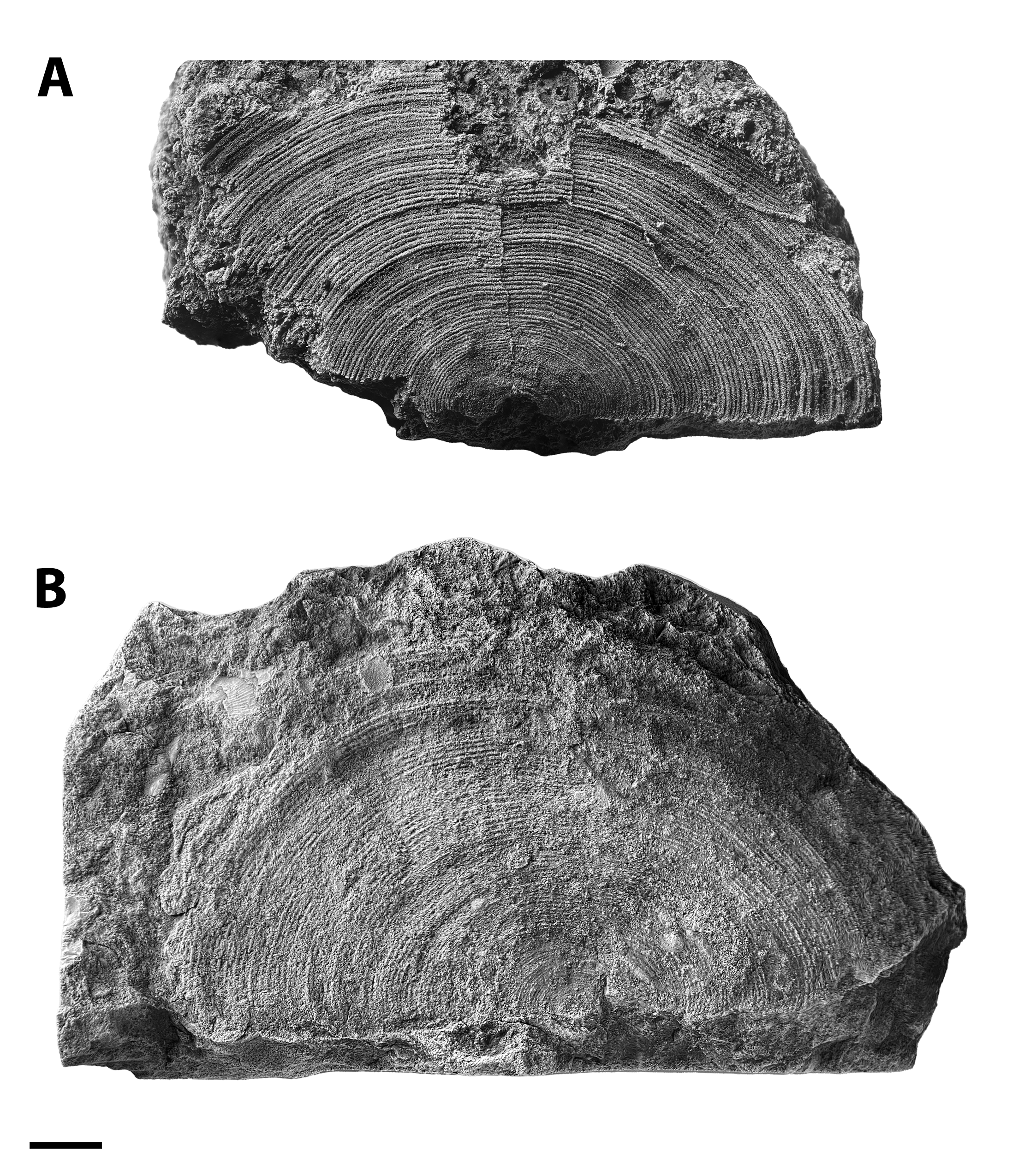
The brachiopod Isogramma Meek and Worthen, 1870, can be difficult for inexperienced collectors to identify. These fossils commonly appear as semicircular shells covered with sharp concentric ridges, resembling the grooves of a vinyl record. The ventral valve has a narrow triangular depression extending from the beak to about mid-shell. Within this depressed area, the concentric growth lines fade or disappear. The dorsal valve lacks this feature.
In this fauna, Isogramma appears to be the largest brachiopod, with some specimens reaching about 18 cm in width. Specimens are usually flattened and often fragmentary, making them difficult to recognize as brachiopod shells. In life, the valves were slightly concavo-convex. Their relatively porous or “spongy” shell structure likely made them prone to flattening after death. Isogramma may also have been delicate in life: many adult specimens show damage and regrowth, visible as abrupt changes in the concentric surface ridges.
Stojanović-Kuzenko (2004) figured unflattened specimens of the species Isogramma serbica from northwestern Serbia. Those figures, especially Plate 1, figures 1–4, help show the life morphology of Isogramma. Chen and Shi (2006) described the genus as “one of the most morphologically characteristic genera among Late Palaeozoic brachiopods” and reconstructed its evolutionary history, including rapid diversification after its origination and a later setback associated with a Mid-Carboniferous extinction event.
Sturgeon and Hoare (1968) reported Isogramma millepunctata from the Lower Mercer Limestone of the Pottsville Group and from the Cambridge Limestone. In Ohio, the Cambridge Limestone corresponds to the Nadine Limestone of Pennsylvania.
North American upper Carboniferous species of Isogramma include I. millepunctata, most common in the Moscovian, relatively small and flat for the genus at up to about 6 cm wide, with sharp ornament; I. texanum Cooper, 1952, from the Gzhelian, similar in size to I. millepunctata but more convex and with very fine concentric ridges; and I. renfrarum Cooper, 1952, reported from the Moscovian through Gzhelian. I. renfrarum is the giant of the genus, approaching 20 cm in width. Externally, it resembles a very large I. millepunctata, but it differs in internal characters that are rarely visible in typical specimens. The specimens shown here are tentatively assigned to I. renfrarum based on size and age.
References
- Cooper, G.A., 1952. Unusual specimens of the brachiopod family Isogrammidae. Journal of Paleontology, 26: 67–83
- Stojanović-Kuzenko S., 2003, A new carboniferous species of isogramma (dyctionellida, brachiopoda) from NW Serbia, Geoloski anali Balkanskoga poluostrva, Issue 65, pp. 47–53
- Sturgeon, M.T., Hoare, R.D., 1968, Pennsylvanian Brachiopods of Ohio, State of Ohio Division of Geological Survey, Bulletin 63, 95 pages, 22 plates.
- Z.Q. Chen, G.R. Shi, 2006, Isogramma Meek and Worthen, 1870 (Dictyonellida, Brachiopoda) from the upper Palaeozoic of East Asia: Implications for biogeography and evolutionary trends, Journal of Asian Earth Sciences, Volume 26, Issues 3–4, pages 405–423

Late Carboniferous Fossils from the Glenshaw Formation in Armstrong County, Pennsylvania
Preface | The Photographic Process
Localities: Locality SL 6533 Brush Creek limestone | Locality SL 6445 Pine Creek limestone
Bivalvia: Allopinna | Parallelodon | Septimyalina
Cephalopoda: Metacoceras | Poterioceras | Pseudorthoceras | Solenochilus
Gastropoda: Amphiscapha | Bellerophon | Cymatospira | Euphemites | Glabrocingulum | Meekospira | Orthonychia | Patellilabia | Pharkidonotus | Retispira | Shansiella | Strobeus | Trepospira | Worthenia
Brachiopoda: Cancrinella | Composita | Isogramma | Linoproductus | Neospirifer | Parajuresania | Pulchratia