

The Fossils of Parks Township is a fossil catalog and independent research entity. Parks is a Township in Armstrong County, one of 67 counties in Pennsylvania. The city of Pittsburgh sits approximately 30 miles to the southwest. Most cataloged and described fossils come from Pennsylvanian-aged strata in Western Pennsylvania.
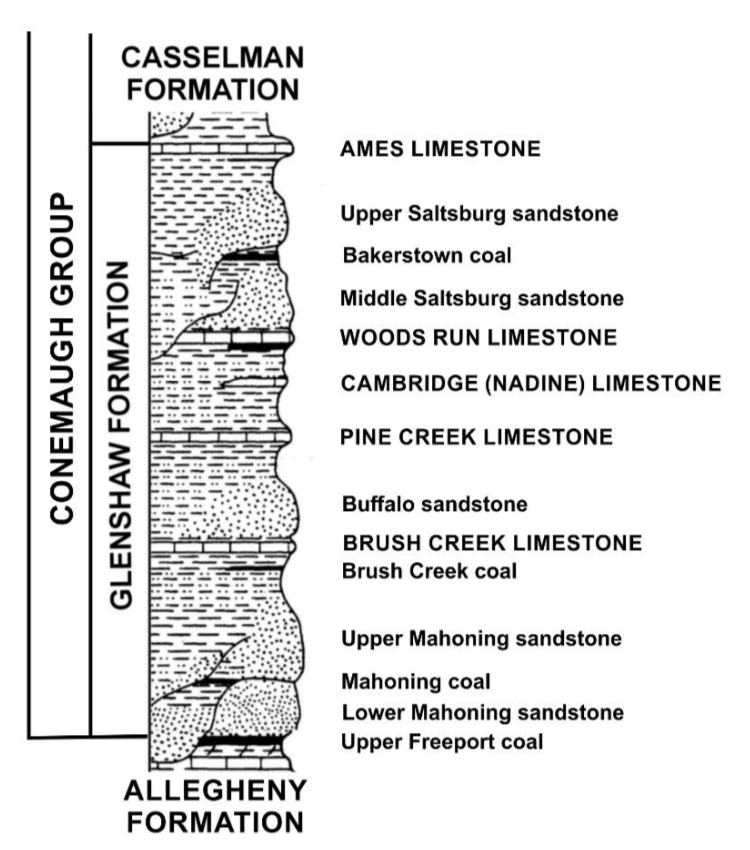
The fossil collection sites explored are within the Glenshaw Formation. The formation consists of a series of ancient sea transgressions and regressions. These regressions laid down repeating layers of limestone, sandstone, and shale. Limestone layers occur within marine zones, with vertical bedrock sections representing marine sediment. These zones carry abundant fossils. Between the zones lies a series of shale and sandstone layers, which can also contain fossils. Limestones here are sediments of ancient, warm, shallow seas. As the planet heated up over several hundreds of thousands of years, global sea levels rose and flooded continental basins. However, there were times when the planet was colder, causing the seas to retreat.
Collection Localities
The marine zone I explore the most in Parks Township is the Brush Creek marine zone, also known as the Brush Creek limestone. However, I also collect often from the Pine Creek marine zone in nearby Kittanning.
The Glenshaw is one of two formations in the Conemaugh Group. The Casselman Formation exists above at the hilltops, about a mile away. The Ames Limestone is the boundary between the Glenshaw and the Casselman.
All fossils I find in Armstrong County are from the Carboniferous period, specifically the Pennsylvanian. This time spans a period of 298.9 – 323.2 million years ago. You can find fossils here in most types of rock. Local rocks include shale, limestone, sandstone, or any of these. Generally, I find fossils between 303 to 307 million years of age.
The Geology of Parks Township, Pennsylvania
One key to finding and identifying fossils is to understand the local geology. The Parks Township Geology page has a high-level overview of the geology within the township boundaries. I also have information about what Parks Township was like during the Carboniferous period. Hint: it was below the Equator.
Publications
In the future, we hope to publish material that better describes the fossil and geological records of Parks Township and neighboring localities. Much of the first couple of years of exploring has involved learning about these topics and finding physical evidence locally. We currently publish in many ways, with this website as the primary source of new material.
Website Publications
This website contains two primary sources of publication—fossil posts and pages. Posts are minor research focused on a single discovery or fossil recovery. One goal is to use as much photography as possible to highly the physical evidence in these finds. Pages are more comprehensive, with topics ranging from Paleontology Research to Parks Township geology. We also publish our fossil catalog, a serialized listing of specimens. While most specimens are local, anything fossil of interest can become a specimen in the collection. Learning can also involve trading with collectors worldwide, and these specimens become part of the collection.
Physical Publications
A critical aspect of paleontology research is publication. The analysis can focus on discoveries or present a collection of research on a particular topic. The authors have described most of the typical local fossil fauna. Yet Western Pennsylvania still has many discoveries left. Most collecting occurs where people dig, on the margins of regionally eroded hillsides, and in quarries. What remains is hundreds of square miles of a single stratum with unrecovered material.
In the past years, I have found species not yet reported and helped at least one author define a new species (pending publication). One known problem facing invertebrate paleontology today is a lack of research funding. Decades ago, getting a research grant to study the available invertebrate fauna was probably easier. Unfortunately, funding for that purpose seems more complex than ever.
I wish to publish:
- Manuscripts for research on fossil genera.
- A local guide for identifying fossils found regionally using photography of locally recovered specimens.
- A manuscript in a peer-reviewed journal.
- Occasional papers that highlight interesting recovered specimens.
- Information sheets. They are available here.
Global and Regional Fossil Information
- PBDB Navigator – Paleobiology Database
- Geology – Pennsylvania Department of Conservation & Natural Resources
- Invertebrate Paleontology – Carnegie Museum of Natural History
- The Field Museum – Focus: Fossil Invertebrates
Other Interesting Fossil Websites
Occasionally I find people doing similar work. Here are some excellent websites for fossil exploration.
- St. Louis Pennsylvanian Fossils of the Altamont Formation – A long-time author with insights from professional paleontologists.
- The Fossils of the Southern Karavanks
- Views of the Mahantango – From a writer in Philadelphia.
- The Coastal Paleontologist
- Equatorial Minnesota
- Louisville Fossils
- TXFossils – Lots from the Pennsylvanian in Texas.
- Trilobite.info
- Kane X. Faucher – Fossil Blog
- Terra Impressions – Fossils of Alabama
- Lask Fossil Collection

Comments are closed, but trackbacks and pingbacks are open.